






Product Description
| Dimensions(mm) | 3D Image |
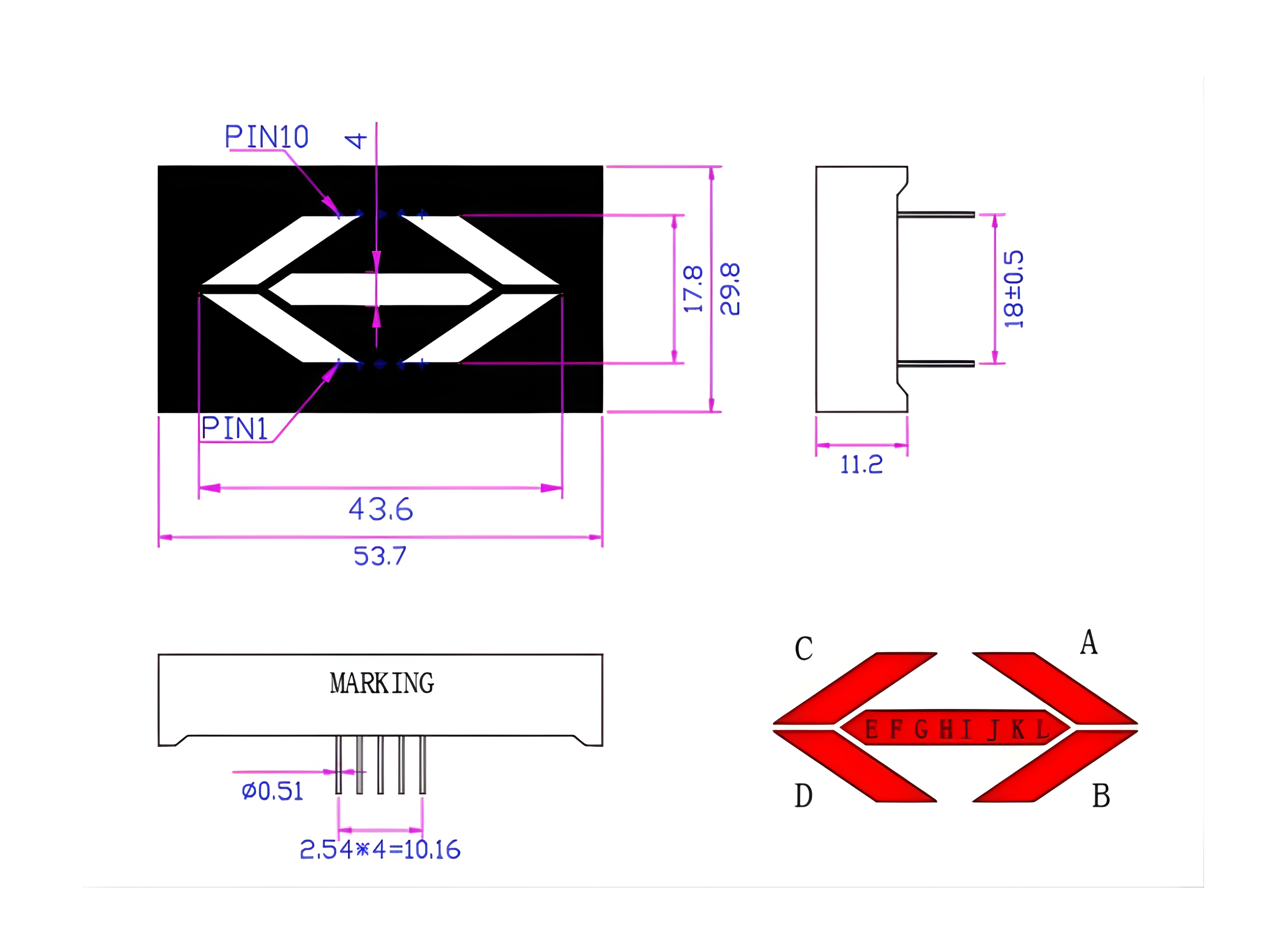 |
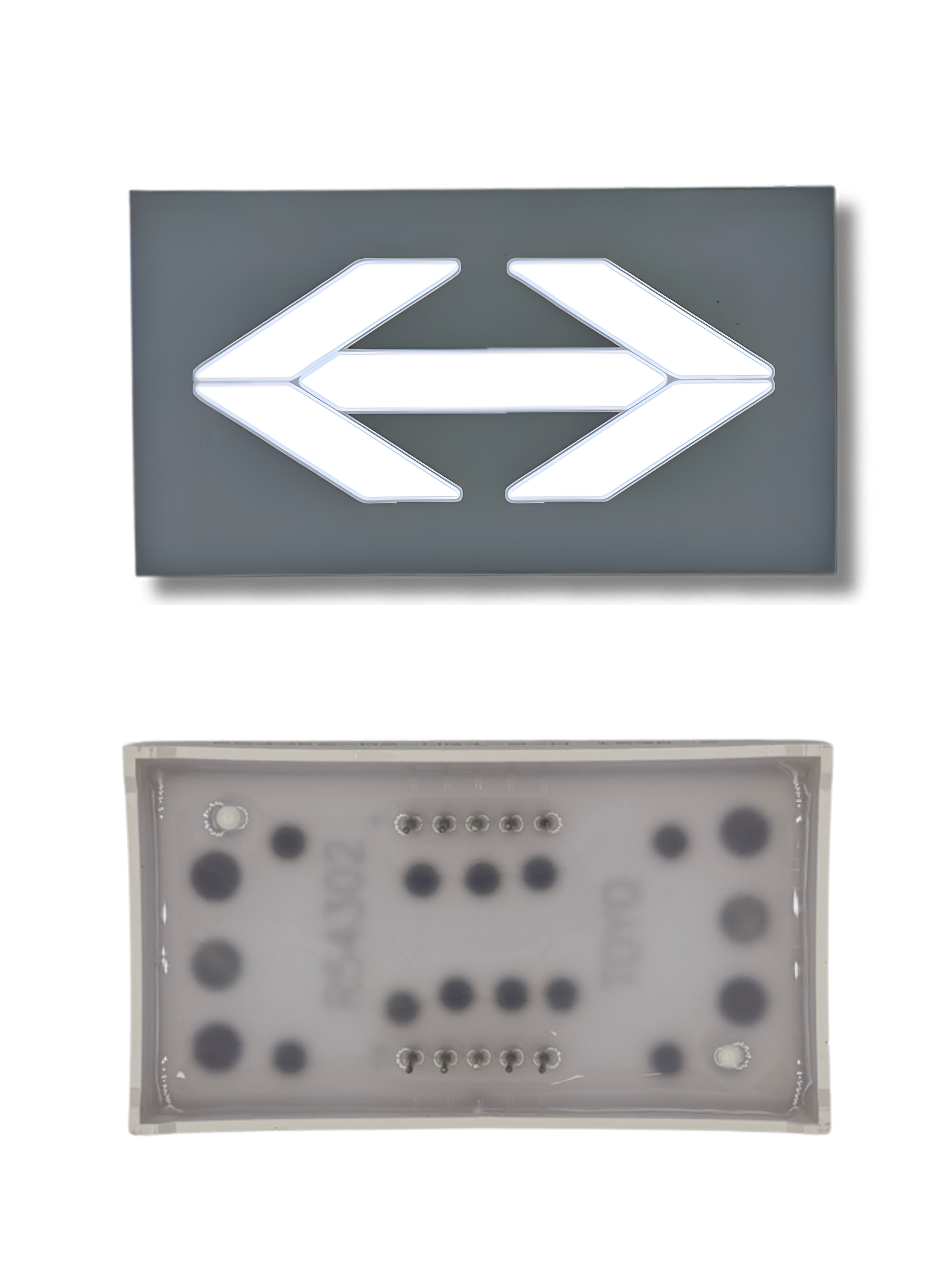 |
|
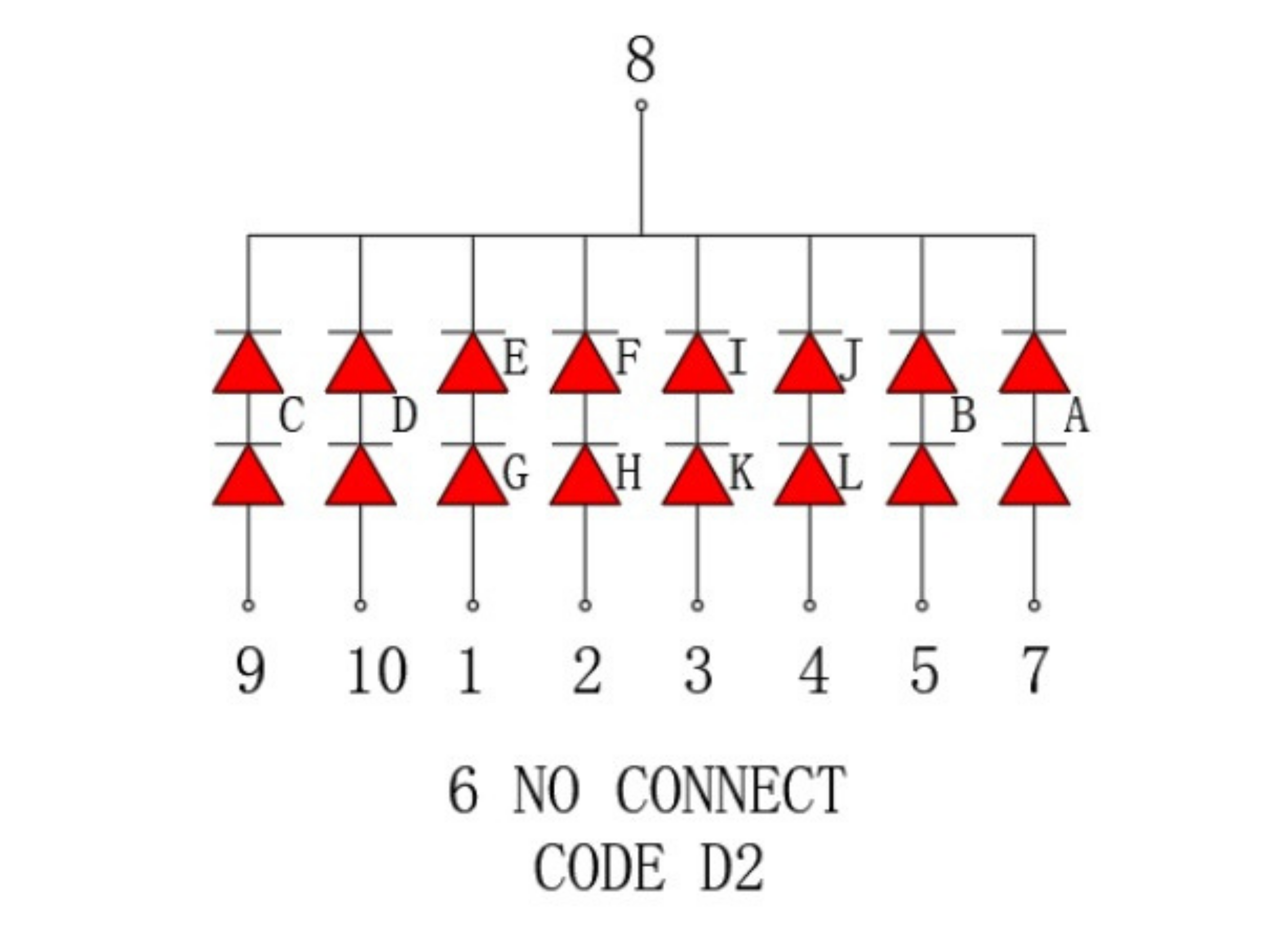
INTERNAL CIRCUIT DIAGRAM |
|
R54302-D2 is a specialized double-arrow LED sign module (also called a bidirectional arrow indicator or direction arrow display) manufactured by TOYO LED Electronics Ltd.
Main features and appearance
Visual design — It shows a clear double-headed arrow symbol →← (left and right arrows pointing outward from the center, forming a kind of “both directions” or “either way” indicator).
The light appearance is bright white (most likely cool/white LEDs), with the arrows strongly illuminated against a dark/grayish background when powered.
When off, the front surface appears somewhat translucent/gray with the arrow shapes visible as lighter areas.
Physical construction
Rectangular/elongated shape
Approximate dimensions (from the drawing):
Overall length ≈ 53.7 mm
Height ≈ 29.8 mm (or 17.8 mm for the active arrow area)
Thickness ≈ 11.2 mm (including any protruding parts)
It has a flat front face with the printed/formed arrow pattern and many small circular diffuser spots (likely one per LED or group of LEDs) arranged in a grid behind the arrow shapes for even light distribution.
Back side — PCB exposed with multiple solder pads/holes (around 10–12 visible) for connection.
Pinout and internal wiring
10 pins total (labeled PIN1 to PIN10).
Internally wired as two independent arrow groups:
One set of LEDs forms the left arrow (←)
The other set forms the right arrow (→)
The circuit diagram shows 12 LED symbols (triangles) connected in parallel groups:
Left arrow uses LEDs labeled C, D, G, H, K, L
Right arrow uses LEDs labeled A, B, E, F, I, J
Pin 6 — No Connect (NC)
Pin 8 — likely common (anode or cathode depending on polarity)
Other pins (1–5, 7, 9–10) connect to the individual groups or commons.
Code D2 — indicates this specific internal configuration / LED grouping/polarity variant (TOYO uses letter codes like D2, A4, etc. for different wirings).
Typical applications
These modules are commonly used in:
Elevator/lift direction indicators (showing “up” and “down”, but here adapted for left/right or bidirectional)
Queue management systems
Traffic/pedestrian signs
Industrial control panels
Arrow guidance in corridors, airports, or retail
Custom LED signage where left/right indication is needed
Electrical notes
Likely driven at low voltage (commonly 5 V, 12 V, or 24 V, depending on series resistors inside — exact voltage/current not visible here).
Designed for direct PCB mounting or integration into larger sign assemblies.